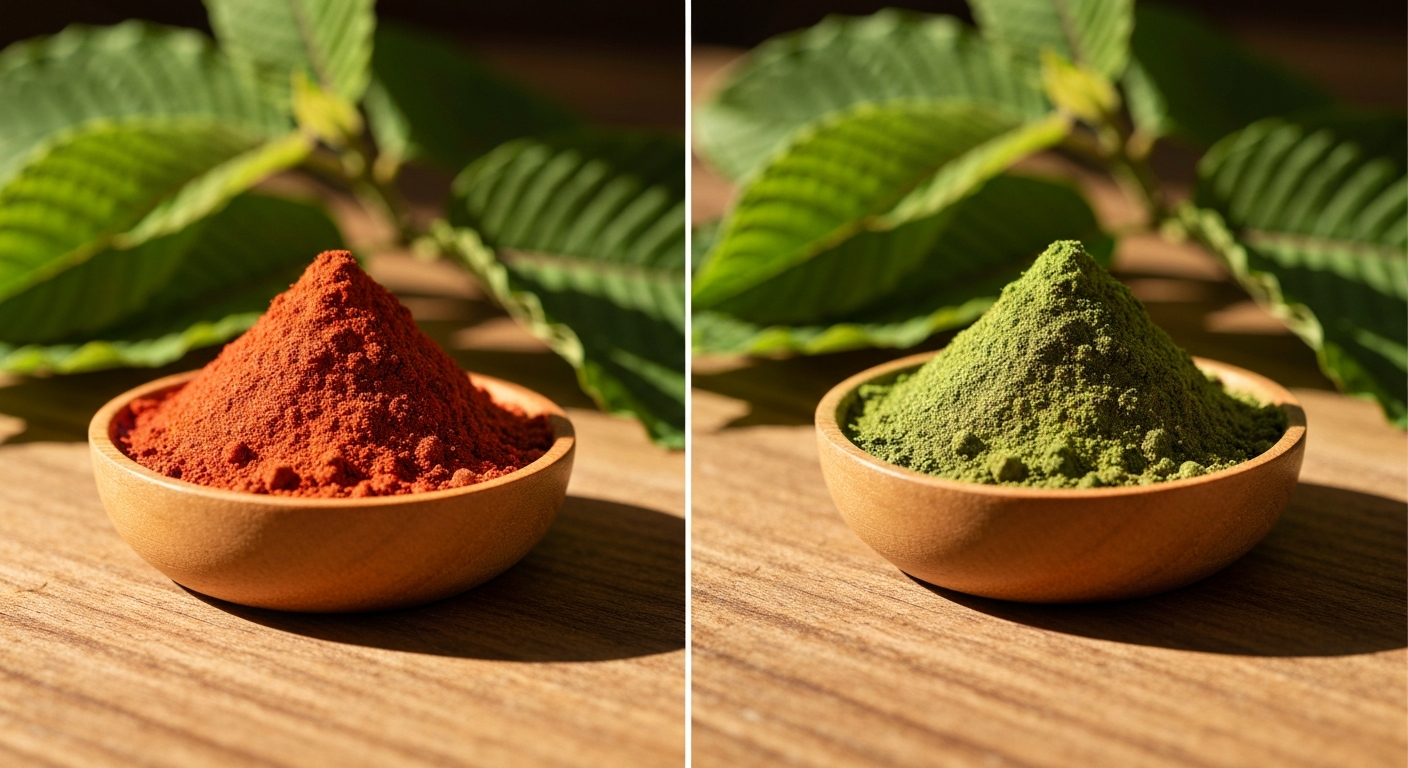
For pain and anxiety, kratom tends to hit fast and hard while CBD works slowly in the background, which is why so many Canadians end up reaching for one, the other, or both. CBD and kratom solve different problems, and kratom is known for exactly the fast, felt relief that CBD can’t deliver on demand. They’re the go-to “natural alternatives” when pharmaceuticals feel like overkill but the pain, the anxiety, the sleepless nights are very real. Both are legal here. Both have loyal followings. And both are buried under enough marketing hype to make the choice genuinely confusing.
So let’s cut through it. Here’s how they really differ on effects, cost, legality, safety, and the situations where one beats the other.
What Each One Actually Is
Kratom
Kratom comes from the ground-up leaves of Mitragyna speciosa, a tree native to Southeast Asia. The active stuff, mitragynine and 7-hydroxymitragynine, plays with your opioid, adrenergic, and serotonin receptors. Vein color and the dose of kratom change everything about how kratom works. The effects of kratom at a low dose feel nothing like a high one.
CBD (cannabidiol)
CBD comes from the hemp plant, Cannabis sativa, as an extract. It has no intoxicating psychoactive effects, so it won’t get you high. Its main job is modulating the endocannabinoid system, which means CB1/CB2 receptor interactions plus some action on serotonin (5-HT1A) and vanilloid (TRPV1) receptors. Notice what’s missing? There’s no meaningful receptor overlap with kratom at all.
Effect Profile Compared
For pain
- Kratom: Direct, noticeable analgesia within 30–45 minutes. Red strains especially shine here, whether it’s chronic pain, an acute injury, or menstrual cramps.
- CBD: Milder and more gradual. It does its best work on inflammation-mediated pain like arthritis and autoimmune conditions. Expect 2–4 weeks of consistent use before the full effect shows up.
For anxiety
- Kratom: Fast relief, again that 30–45 minute window. Great for acute anxiety, social situations, event-specific nerves. Red Bali and Red Maeng Da are the strains people gravitate toward.
- CBD: Gradual, builds with daily use. Excellent for generalized anxiety over a span of weeks. It just doesn’t deliver acute relief on demand.
For sleep
- Kratom: Red strains at 4–5 g knock people out cold, reliably, for a solid 6–8 hours.
- CBD: Gentler sedative effects. Often paired with melatonin or CBN in a sleep-focused CBD product. On its own? Less dependable.
For energy / focus
- Kratom: Whites and greens boost energy with clean, coffee-like stimulating effects.
- CBD: Not stimulating. If anything, slightly relaxing. It’s not a focus tool, full stop.
For inflammation
- Kratom: Mild anti-inflammatory effect, though it works more by suppressing pain than by tackling the mechanism.
- CBD: Significant anti-inflammatory activity. This is where CBD genuinely earns its keep.
Cost Comparison (Canadian Prices, 2026)
| Product | Price per dose | Effective dose | Monthly cost (1x daily) |
|---|---|---|---|
| Kratom powder | $1–4 | 2–4 g | $30–120 |
| CBD oil (full spectrum) | $2–8 | 25–50 mg | $60–240 |
| CBD gummies | $3–6 | 25 mg | $90–180 |
| CBD isolate | $2–4 | 25–50 mg | $60–120 |
Dose for dose, kratom usually runs 30–50% cheaper. Where CBD lands depends entirely on whether you need full-spectrum, which costs more but does more, or isolate, which is the budget route.
Safety Comparison
Kratom risks
- Physical dependence with daily use
- Rare liver concerns with chronic heavy use
- Dangerous interactions with alcohol, benzodiazepines, opioids
- Nausea, constipation, sweating at higher doses
CBD risks
- Drowsiness at high doses
- Interactions with blood thinners, seizure medications, some antidepressants (CYP450 system)
- Rare liver enzyme elevations at very high doses
- Quality and purity issues in unregulated markets
And how strong is the evidence for CBD, really? Stronger than the skeptics assume. In a landmark New England Journal of Medicine trial, purified CBD cut monthly convulsive seizures from 12.4 to 5.9, while placebo barely moved the needle, going from 14.9 to 14.1 (Devinsky et al., 2017, New England Journal of Medicine). So the benefits of CBD are real when you use CBD for the right job. For casual users who use kratom moderately, the safety comparison still tilts toward CBD. Kratom hits harder but carries more dependence potential. Used moderately by healthy adults, neither is dangerous.
Legality in Canada
Kratom
You can possess it legally anywhere in Canada, since it’s not controlled under the Controlled Drugs and Substances Act. Health Canada hasn’t authorized it for human consumption though, so kratom may only be sold as a botanical, without health claims. Simple in practice, grey on paper.
CBD
CBD is legal under the federal Cannabis Act and sold through provincial cannabis retailers (OCS in Ontario, BC Cannabis Stores, and so on) plus licensed online shops. Hemp-derived CBD sold outside those licensed channels is technically non-compliant, yet it’s everywhere.
Bottom line: kratom has the simpler retail path. No prescription, no government cannabis store. Order online, wait for the package. For more, see our legality guide.
Can You Take Kratom and CBD Together?
Yes. Plenty of Canadians combine CBD and kratom. Because they work through different mechanisms, this use of kratom alongside a daily CBD baseline can deliver broader, smoother pain relief than either one solo.
Common combinations
- Kratom (red) + CBD for pain: Kratom handles the immediate analgesia while CBD chips away at inflammation
- Kratom (green) + CBD for anxiety: Kratom’s fast onset, CBD’s daily baseline
- Kratom (red) + CBD for sleep: Layered sedation, neither one cranked to a high dose
Start low on both. And don’t stack either with alcohol or sedatives.
Who Should Choose Kratom
- You need pain relief that actually works
- You want energy or focus options too
- You’re looking for an affordable daily option
- You value fast onset over gradual baseline
- You don’t want the cannabis-industry retail experience
Who Should Choose CBD
- Your primary concern is inflammation (arthritis, autoimmune)
- You want something very gentle with minimal dependence risk
- You’re sensitive to kratom’s nausea or constipation
- You’re on medications that don’t mix with opioid-receptor activity
- You prefer a tincture or gummy format over powder
What About Hemp Seed Oil?
Quick warning here. Hemp seed oil has no CBD and no meaningful active compounds. It’s a nutritional oil, not a therapeutic one. If you grabbed something labeled “hemp oil” expecting CBD effects, flip it over and check for a specific cannabidiol mg count.
Best Kratom Strains for CBD Users
If you’re coming from CBD, you’ll probably want the gentler, more balanced kratom strains:
- Super Red Bali for relaxation
- Green Bali for mild balance
- Super Green Malay for daytime mood support
Kratom vs cbd questions
Which works faster?
Kratom, no contest. Around 30–45 minutes versus CBD’s 45–90 (oil) or 60–120 (gummies). Even kratom tea beats CBD gummies.
Which is better for chronic pain?
Kratom for acute and moderate pain, CBD for the inflammation-driven kind. A lot of chronic pain patients just use both.
Will CBD make me fail a drug test?
Maybe. Full-spectrum CBD carries trace THC (up to 0.3%), and heavy use can trigger a positive THC result. Isolate or broad-spectrum is the safer bet. Kratom, on the other hand, doesn’t show up on standard drug tests.
Can I take both daily?
You can, but mind the dose. Daily kratom can build dependence. Daily CBD rarely does.
Want to Try Kratom First?
Browse our full lineup. Free Canada-wide shipping over $99 CAD. Same-day shipping before 11 AM PST.
Stacking kratom and CBD together: the pragmatic guide for Canadians
Different mechanisms, clean stack. That’s the short version. The most common stacks among Canadian users hit pain or anxiety from two angles at once: kratom for the fast-onset symptom relief, CBD for the slower baseline shift underneath. Done right, the pair outperforms either one going solo.
Take chronic inflammatory pain, arthritis being the classic example. A typical stack is daily CBD oil at twenty-five to fifty milligrams in the morning, then a red kratom dose of three to four grams when pain flares. CBD tamps down the inflammation feeding the underlying pain. Kratom mops up the breakthrough discomfort inside forty-five minutes. The combo often shrinks or erases the need for daily ibuprofen, which adds up over years of managing pain.
Anxiety flips the script a little. Daily CBD at twenty to forty milligrams sets the baseline mood and stress-response improvement that accrues across two to four weeks of steady use. Kratom steps in for the acute stuff: social anxiety before an event, the onset of panic, a night of broken sleep. Two to three grams of red Bali for those specific moments, capped at three to four times a week, keeps dependence at bay while leaving the fast relief on tap.
Then there’s cost. CBD in Canada runs sixty to two hundred dollars a month depending on potency and source, while kratom averages seventy-five to a hundred and fifty for the same pattern of use. Even combined, it undercuts most prescription alternatives and tolerates better. One rule: buy CBD from a licensed provincial retailer for purity and accurate dosing, and buy kratom only from a vendor that publishes third-party lab tests.
Why most Canadians who tried CBD alone come back disappointed
We hear the same story over and over from Canadian customers. They tried CBD for six weeks, dropped two or three hundred dollars on it, felt basically nothing, and walked away convinced the whole category is a scam. Sometimes they’re right and the product really was weak or fake. More often, though? They tried CBD without grasping what it’s actually good at and what it isn’t.
CBD shines for inflammation-driven conditions and for slow baseline shifts in mood and stress response. Think arthritis joint pain, autoimmune flare frequency, the generalized anxiety that’s been hanging around for years. The effect builds over four to eight weeks of consistent daily dosing at therapeutic levels, usually twenty-five to fifty milligrams a day for adults. Most disappointed users took too little, for too short a stretch, expecting the fast acute hit that CBD simply doesn’t deliver.
Here’s what CBD won’t do. It won’t kill acute pain. It won’t calm a full-blown panic moment. It won’t shut down a racing mind at bedtime. Kratom handles all three at the right doses. Try to draft CBD for those acute jobs and you’ll be let down nearly every time, and that letdown ends up tainting your whole impression of the substance, even though you were asking it to do work it was never built for.
So what’s the sensible verdict for most Canadians? CBD as a daily baseline supplement at therapeutic doses, plus kratom for the acute moments, beats either one alone. Combined, that lands around a hundred and fifty to two hundred and fifty dollars a month for moderate users, which is comparable to or cheaper than most prescription routes, with a friendlier tolerability profile. Cut CBD loose if eight weeks of proper dosing got you nowhere. Keep kratom for the acute moments where it actually earns its spot.
Educational only. Not medical advice.
Looking to order kratom online in Canada? Kratom Active ships lab-tested red, green, and white vein strains across the country, with tracking and free shipping on qualifying orders.