Maeng da kratom has the biggest reputation in the entire kratom world. Ask around and you’ll hear it’s the strongest, the smoothest, the original premium strain of kratom. But walk into that reputation as a buyer and you immediately hit a fork: red maeng da or green maeng da? Same name, noticeably different experiences. Having sold both for years and read thousands of customer notes, here’s our honest breakdown of how they compare and which fits which person.
First, What Maeng Da Actually Means
This piece assumes you have settled on Maeng Da and are choosing between two veins. For the wider picture, including white, sourcing and lab testing, start with our guide to Maeng Da kratom in Canada.
Maeng da isn’t a place or a botanical variety. The name comes from Thai slang, roughly translating to “pimp grade,” and it started as a marketing term for the strongest leaf a supplier carried. Over time it stuck to a particular style: kratom grown from mature, carefully selected Mitragyna speciosa trees, often using grafted stock, harvested late for maximum alkaloid content. Thailand gave it the name, though most maeng da kratom today grows in Indonesia.
What makes maeng da strains stand out chemically is density. Lab work on commercial samples consistently shows higher total alkaloid content than average leaf, with more mitragynine and slightly elevated 7-hydroxymitragynine. Higher octane fuel, same engine. The vein color then decides what that extra potency feels like.
Vein Color: Where Red and Green Split
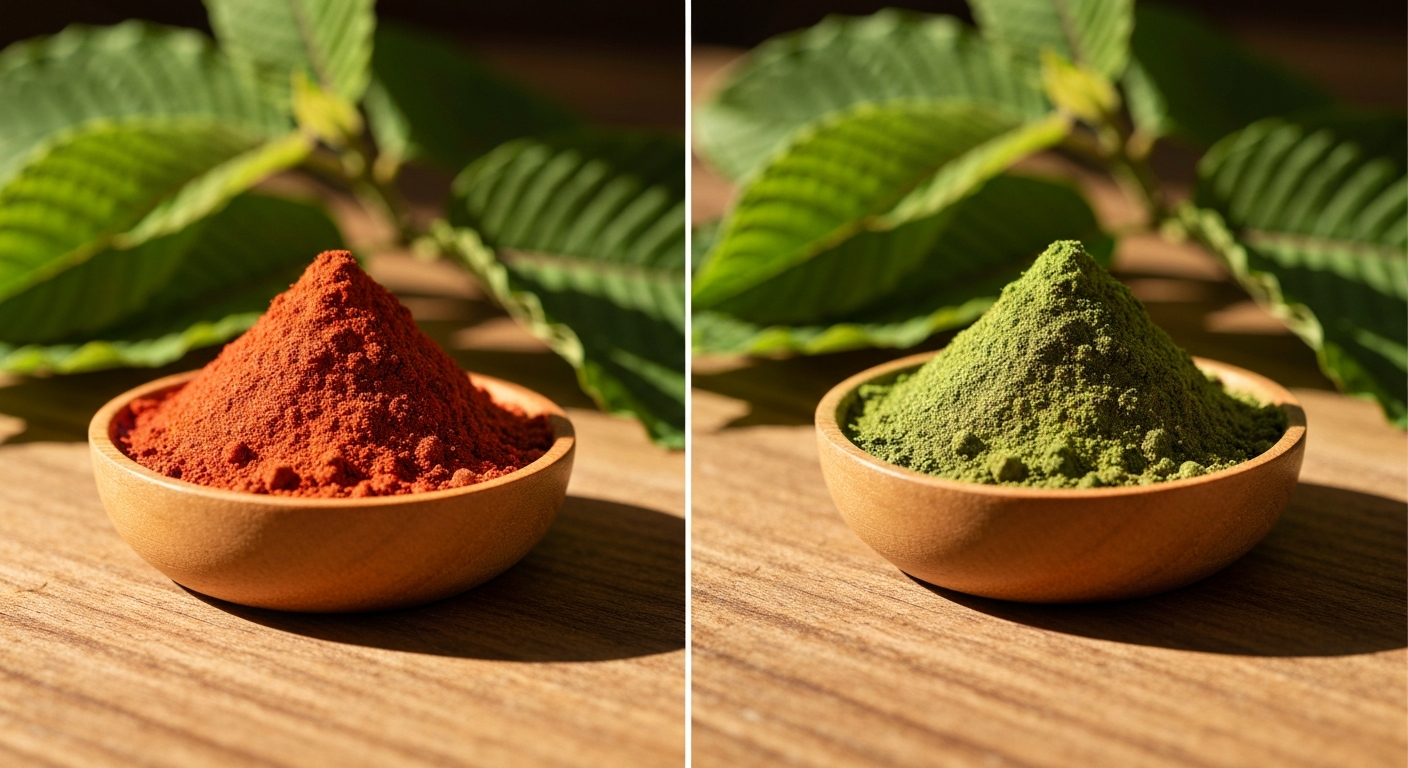
Red vein and green vein refer to the central rib of the kratom leaf at harvest, and the difference carries through drying into the finished kratom powder. Red vein kratom comes from the most mature leaves and gets a longer, often sunlight-heavy drying process that shifts the alkaloid profile toward the relaxing end. Green vein kratom is picked at middle maturity and dried mostly indoors, preserving a balance between the stimulating and calming compounds.
Same tree, different timing and treatment, meaningfully different effects. That’s the entire story of vein color across different kratom strains, and maeng da just tells it at higher volume.
Red Maeng Da: Character and Best Use
Red maeng da delivers what red kratom strains are known for, with extra push behind it. The experience most kratom users report is a warm, body-forward calm that arrives within the hour and holds for four to six. Compared with a classic like red Bali, it keeps a thread of alertness running through the relaxation, which is why people call it the daytime red. It relaxes without switching you off.
Where it shines: evening unwinding, tense shoulders after physical work, and those late afternoons when you want quiet without a nap. At lower doses the alert thread is more noticeable. Higher doses push firmly toward the sedative end, as with any red.
Green Maeng Da: Character and Best Use
Green maeng da is our best seller for a reason. It takes the balanced effects green kratom is famous for and sharpens them: clean energy, focus, and a mood lift that lands quickly and stays smooth. People reach for it the way others reach for a strong coffee, minus the jitters. Duration runs about four to five hours, with the energetic phase up front and a mellow tail.
Where it shines: work mornings, study sessions, workouts, social afternoons. It’s also the maeng da we’d hand to newer users first, since the balanced profile is more forgiving than the full commitment of a red. Sensitive users should still start small. Maeng da of any color runs stronger than typical kratom.
Head to Head: The Differences That Matter
Energy is the clearest divider. Green maeng da adds it, red maeng da spends it. If you need to function sharply for the next few hours, green. If the day’s work is done, red.
Timing follows the same logic. Greens fit mornings and early afternoons. Reds fit evenings, though red maeng da’s mild lift makes it the rare red some people use earlier without feeling buried.
Dosage sensitivity differs a little too. Both are potent, but users report the character of green maeng da stays fairly stable as the dose rises, while red maeng da transforms, light and relaxing at lower doses, heavily sedating at higher doses. Whichever you pick, the standard advice holds: start with one to two grams, wait a full hour, and adjust in small steps. Our dosage guide covers this properly.
Side effects overlap almost completely, as you’d expect from the same plant. Nausea and dizziness from taking too much, dry mouth, and with heavy daily kratom use, tolerance and the risk of dependence with withdrawal symptoms on stopping. Reds used nightly seem to build habits slightly faster in practice, mostly because sleep routines invite daily use. Moderation and rest days handle most of it, and our tolerance guide goes deeper.
Can You Use Both?
Plenty of experienced users do exactly that: green maeng da as the daytime workhorse, red maeng da for evenings. Rotating between the two also slows tolerance compared with hammering one strain daily, since the alkaloid balance differs enough to vary the receptor load. If you’re choosing your first bag and can only pick one, decide by when you’d actually use kratom. Mostly before 5 PM, go green. Mostly after, go red.
And if maeng da’s intensity sounds like more than you need, gentler options in each color exist. Green Bali and Super Red Bali cover the same territory at an easier pace. The full strains guide compares everything we carry.
Quality Notes for Canadian Buyers
Because maeng da commands premium prices, the label gets slapped on plenty of ordinary powder. Genuine maeng da should come with lab results showing above-average mitragynine, typically pushing toward the upper end of the natural 1 to 2 percent range. Both of ours are third-party tested batch by batch for alkaloid content, heavy metals, and microbes, and ship same-day from Vancouver across Canada. Whoever you buy from, ask for those numbers. The name is free. The potency has to be proven.
Frequently Asked Questions
Which is stronger, red or green maeng da?
Total potency is similar. The difference is direction, sedating versus energizing, not strength. Dose for dose they’re both at the strong end of kratom varieties.
Is white maeng da worth considering too?
If maximum stimulation is the goal, yes. White maeng da is the most energizing of the three, best suited to experienced users who tolerate white vein kratom well.
Can beginners start with maeng da?
Yes, with green and a small first dose. Its balanced profile behaves predictably. Red maeng da works for beginners too, just expect real sedation if you go past two grams early on.
Why does my maeng da feel different between batches?
Alkaloid content varies naturally with harvest and drying. Buying from a vendor with single-origin sourcing and batch testing keeps that variation small. Random-sourced maeng da can swing widely.
Bottom Line
Red maeng da and green maeng da share a name, a plant, and a potency tier, then walk in opposite directions. Green is the sharp, motivated daytime strain. Red is the strong, calm evening one that never quite loses its spark. Neither is better. They’re tools for different hours of the same day, and knowing that is really all it takes to choose well.
Educational only. Not medical advice. Kratom is not authorized by Health Canada for human consumption.